
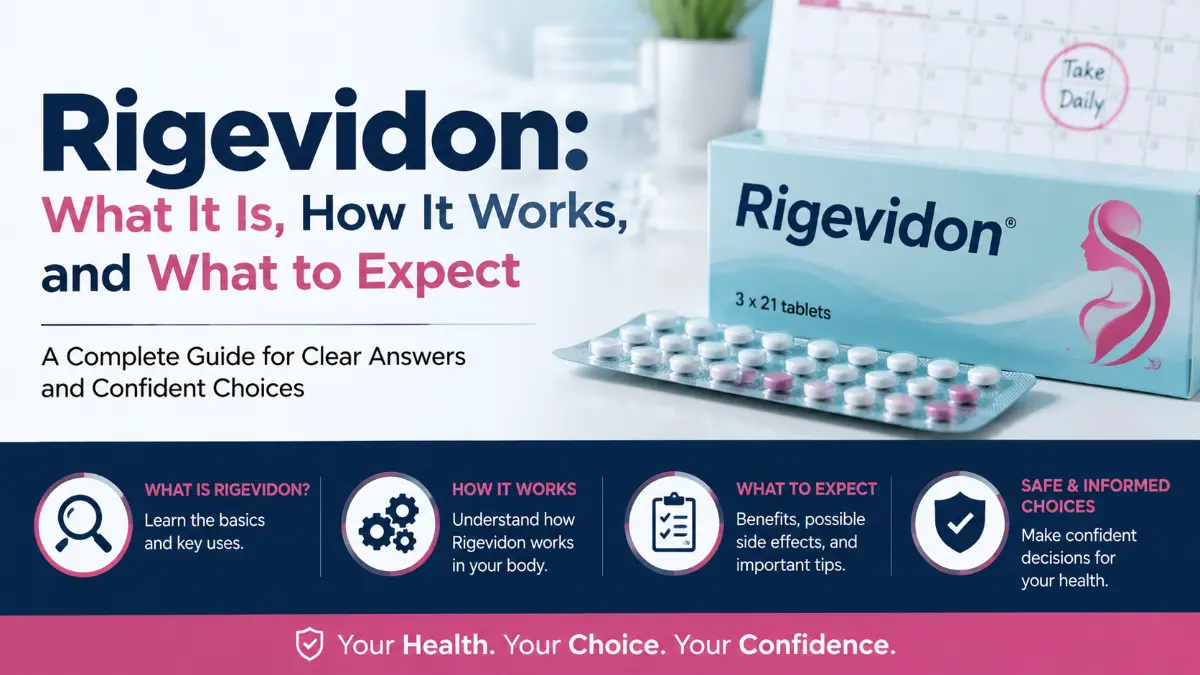
Rigevidon is a combined oral contraceptive pill used to prevent pregnancy. Each tablet contains 30 micrograms of ethinylestradiol (an oestrogen) and 150 micrograms of levonorgestrel (a progestogen), taken as a 21-day pill with a 7-day break.
Rigevidon is available through NHS contraceptive services and other UK prescribing routes when a clinician considers it suitable for the individual. Like other combined hormonal contraceptives, it is not appropriate for everyone: it can increase the risk of blood clots and may be unsuitable for people with certain medical conditions or risk factors.
How Rigevidon Prevents Pregnancy
Rigevidon mainly prevents pregnancy by suppressing ovulation, so the ovaries don’t release an egg. The hormones also thicken cervical mucus, making it harder for sperm to reach an egg, and they alter the uterine lining.
With perfect use, combined pills are more than 99% effective at preventing pregnancy. With typical use-where pills are sometimes missed or taken late-effectiveness is closer to 91%. Rigevidon does not protect against sexually transmitted infections. Condoms are needed for STI protection.
How to Take Rigevidon
Take one tablet each day for 21 consecutive days, then take a 7-day break with no tablets. A withdrawal bleed usually happens during this break, typically starting on day 2 or 3 after the last active tablet. Start the next pack after the 7-day break.
Try to take the tablet at approximately the same time every day. If you’re starting Rigevidon for the first time with no hormonal contraception in the previous month, tablet-taking should begin on day 1 of your natural cycle (the first day of your period).
Also Read: What Is an Internal Medicine Doctor? Complete Guide to Care
When Does Rigevidon Start Protecting You?
If you start on the first day of your period, you are protected against pregnancy immediately, per the product’s official dosing guidance. NHS guidance frames this more broadly as “the first 5 days of your cycle” for combined pills generally.
If you start later than this, use additional contraception, such as condoms, for the first 7 days of tablet-taking. If there’s a chance you were already pregnant when starting, speak to a healthcare professional about when to take a pregnancy test.
What to Do If You Miss a Rigevidon Pill
Rigevidon’s own product information (SmPC) sets a clear 12-hour threshold, and the advice beyond that depends on which week of the pack you’re in.
Less than 12 hours late: Protection is not reduced. Take the missed tablet as soon as you remember, and take the rest of the pack at the usual time.
More than 12 hours late-Week 1: Take the last missed tablet immediately, even if it means taking two tablets the same day, then continue as normal. Use a barrier method (such as condoms) for the next 7 days. If you had unprotected sex in the 7 days before the missed tablet, pregnancy is possible-speak to a pharmacist, GP, or sexual health service promptly, as you may need emergency contraception.
More than 12 hours late-Week 2: Take the last missed tablet as soon as you remember and continue the pack normally. If every tablet in the 7 days before the miss was taken correctly, no extra contraception is needed. If not-or if more than one tablet was missed-use a barrier method for 7 days.
More than 12 hours late-Week 3: This is the highest-risk scenario because it sits close to the tablet-free break. The SmPC gives two accepted options: take the missed tablet and start the next pack immediately with no tablet-free interval, or take the missed tablet and keep to a tablet-free break of up to 7 days total (counting the days already missed) before starting the next pack. Use a barrier method for 7 days if the prior week wasn’t taken correctly.
The underlying rule behind all of this: active tablet-taking should never be interrupted for more than 7 days, because 7 consecutive days of correct tablet-taking are needed to reliably suppress ovulation. If you’re unsure, check your patient information leaflet or speak to a pharmacist-Rigevidon’s own leaflet gives slightly simplified wording for patients that mirrors the clinical SmPC advice above.
What If You Vomit or Have Diarrhoea?
Vomiting or severe diarrhoea can stop Rigevidon’s hormones from being properly absorbed. If this happens within 3-4 hours of taking a tablet, the SmPC advises taking a replacement tablet as soon as possible-ideally within 12 hours of your usual dose time. If more than 12 hours pass, follow the missed-tablet instructions above.
NHS guidance also recommends using additional contraception throughout a prolonged illness and continuing precautions until you’ve taken the pill normally for 7 days without vomiting or diarrhoea.
Who Can and Cannot Take Rigevidon?
Rigevidon is suitable for many people who want a combined hormonal contraceptive, but a prescriber must weigh your medical history and clotting risk first.
According to Rigevidon’s SmPC, it must not be used if you have, or have had:
- A venous thromboembolism (VTE)-current or past DVT or pulmonary embolism-or a known clotting disorder such as Factor V Leiden or protein C/S deficiency
- An arterial thromboembolism (e.g. heart attack) or stroke, including a history of migraine with focal neurological symptoms (migraine with aura)
- Severe or uncontrolled high blood pressure, or severe diabetes with vascular complications
- Severe liver disease, or a current/past liver tumour
- Known or suspected hormone-sensitive cancer, such as certain breast cancers
- Undiagnosed vaginal bleeding
- A serious combination of multiple risk factors for clotting (e.g. smoking plus age 35+ plus obesity)
Rigevidon is also contraindicated alongside certain hepatitis C medicines and St John’s wort. This list is not exhaustive-a doctor, nurse, or pharmacist must assess your full individual history before you start or continue Rigevidon.
Read More: Knee Cartilage: Damage, Repair, Exercises & Treatment Guide
Blood Clot Risk
Combined hormonal contraceptives are associated with an increased risk of venous thromboembolism (VTE), including deep vein thrombosis and pulmonary embolism. The absolute risk stays small, but it varies by contraceptive type, age, and personal medical history.
To put a number on it: Rigevidon’s own SmPC states that among 10,000 women who don’t use combined hormonal contraception and aren’t pregnant, about 2 will develop a VTE in a year. Among 10,000 women using a levonorgestrel-containing pill like Rigevidon, that figure rises to roughly 6. FSRH guidance places this in context: current combined hormonal contraceptive use carries a 3- to 3.5-fold increase in VTE risk compared with non-use, though the absolute number of events stays low, and risk is lower on the pill than during pregnancy or the postpartum period.
Seek urgent medical attention if you notice:
- Painful swelling in one leg
- Sudden or unexplained breathlessness
- Chest pain, especially if it worsens with breathing
- Coughing up blood
- Sudden neurological or visual symptoms
Do not ignore these symptoms-tell any healthcare professional you see that you’re using a combined hormonal contraceptive.
Common Side Effects of Rigevidon
Like other combined pills, Rigevidon can cause side effects, and these often ease within the first few months as the body adjusts, though this varies by person. According to the SmPC’s reported adverse effects, these include:
- Nausea and abdominal pain
- Headaches and dizziness
- Breast pain or tenderness
- Mood swings, including depression, and altered libido
- Changes in menstrual bleeding, including breakthrough bleeding or spotting
- Acne or other skin changes
NHS guidance notes that while weight changes can occur during hormonal contraceptive use, there isn’t enough evidence to say hormonal contraception directly causes these changes in every person. If side effects are persistent, severe, or affecting your quality of life, speak with a GP, pharmacist, or sexual health professional-another method may suit you better.
Rigevidon and Cancer Risk
The relationship between combined hormonal contraception and cancer isn’t a simple “increases risk” statement. NHS guidance states that combined hormonal contraception can slightly increase the risk of some cancers, including breast and cervical cancer, while reducing the risk of others, including womb and ovarian cancer.
Rigevidon’s SmPC adds detail: a meta-analysis of 54 studies found a slightly increased relative risk of breast cancer diagnosis in current COC users, which fades over the 10 years after stopping-and because breast cancer is rare under 40, the excess number of cases is small. Your individual risk depends on age, medical history, and duration of use. Discuss personal concerns with a healthcare professional.
Other Uses of Rigevidon
Rigevidon is licensed specifically as an oral hormonal contraceptive. Combined hormonal contraception more broadly can make periods more regular, lighter, and less painful, and combined pills are sometimes used to help manage menstrual symptoms linked to conditions like PCOS.
Rigevidon should not be described as a specific cure or treatment for PCOS. Treatment choice depends on your symptoms, reproductive goals, and overall medical picture.
Medicines and Supplements That Can Affect Rigevidon
Some medicines and herbal remedies reduce how well Rigevidon works by speeding up how the body clears its hormones. NHS guidance advises checking with a doctor or pharmacist if you take medicines for:
- Tuberculosis (TB)
- Epilepsy
- HIV
Rigevidon’s SmPC specifically names enzyme-inducing drugs including certain barbiturates, carbamazepine, phenytoin, rifampicin, and the HIV medicines ritonavir, nevirapine, and efavirenz, plus griseofulvin, topiramate, and St John’s wort-the last of which is an outright contraindication, not just a caution. Modafinil, vemurafenib, and high-dose perampanel are also flagged as reducing contraceptive reliability. Lamotrigine can also be affected in the other direction-Rigevidon may lower lamotrigine levels. Always tell your prescriber about every prescription medicine, over-the-counter medicine, and herbal product you take.
Is Rigevidon Available on the NHS?
Rigevidon is one of the ethinylestradiol/levonorgestrel combined pill formulations used in UK prescribing, and NICE lists it among 30 microgram ethinylestradiol / 150 microgram levonorgestrel products.
Whether you’re prescribed Rigevidon specifically depends on local formulary decisions, your medical history, stock availability, and clinical suitability. Contraception obtained through NHS services in England is generally provided free of charge, though the exact service you access it through can vary.
Is Rigevidon the Same as Microgynon 30?
Rigevidon and Microgynon 30 contain identical active ingredients at identical strengths:
| Medicine | Ethinylestradiol | Levonorgestrel |
| Rigevidon | 30 micrograms | 150 micrograms |
| Microgynon 30 | 30 micrograms | 150 micrograms |
NICE lists both among 30/150 microgram ethinylestradiol/levonorgestrel combined pills. Medicines with matching active ingredients and strengths can be therapeutically equivalent, but formulations may differ in inactive ingredients (Rigevidon’s tablets, for instance, contain lactose and sucrose ) and physical characteristics. Do not switch contraceptive brands without following the advice of your prescriber or pharmacist.
Frequently Asked Questions
Does missing one Rigevidon pill mean I could get pregnant?
Not necessarily. If the tablet is less than 12 hours late, protection isn’t reduced, per the product’s official dosing information. Beyond 12 hours, risk depends on which week of the pack you’re in and whether other tablets were missed.
Can I take two Rigevidon pills in one day?
Yes, in some missed-pill situations. The SmPC specifically instructs taking the last missed tablet as soon as you remember, even if that means two tablets on the same day. If you’ve taken extra tablets by accident and are worried, speak to a pharmacist-an extra combined pill isn’t expected to cause serious harm, though nausea or spotting can occur.
Can I stop taking Rigevidon?
Yes, but contraceptive protection ends as soon as you stop, and stopping partway through a pack can cause irregular bleeding. Arrange an alternative method before stopping if you don’t want to become pregnant.
Does Rigevidon protect against STIs?
No. It prevents pregnancy only. Condoms are required for STI protection.
Can Rigevidon make periods lighter?
Combined hormonal contraception commonly makes periods more regular, lighter, and less painful.
What should I do if I’m unsure whether I missed a pill?
Check your patient information leaflet. If you’re still unsure, speak with a pharmacist, GP, or sexual health service-emergency contraception may sometimes be needed after missed pills.
Does Rigevidon prevent pregnancy immediately?
It depends on when you start. Starting on day 1 of your cycle gives immediate protection, per the product’s dosing instructions. Starting later means you need additional contraception for 7 days.
