
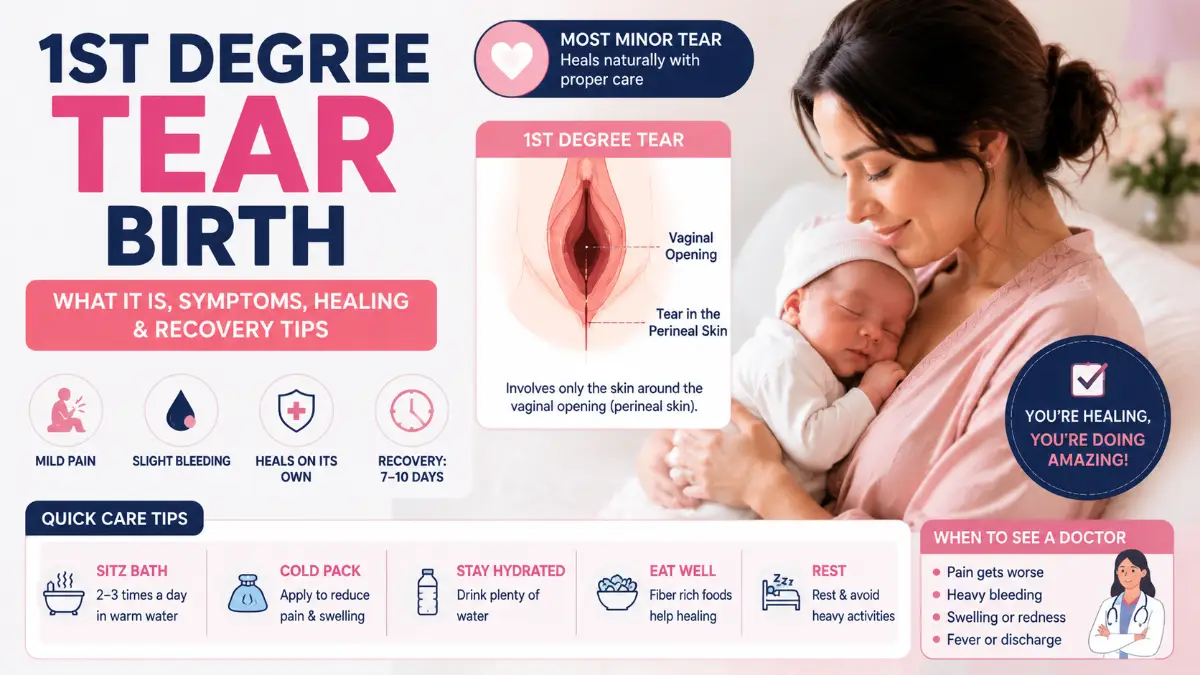
A 1st degree tear birth injury is the mildest category of perineal tearing associated with vaginal delivery. It is superficial and does not extend into the perineal muscles or anal sphincter. Although the area can sting, feel swollen, and make sitting or urinating uncomfortable in the first days after birth, first-degree tears generally heal quickly and are unlikely to cause long-term problems.
Recovery is better understood as a gradual process than as a strict calendar. One person may feel substantially better within days, while another remains tender for several weeks. This timeline explains what may happen at each stage, what you can do for comfort, and which symptoms should be checked by a healthcare professional.
Medical note: This article provides general postpartum education and cannot determine how well an individual tear is healing. Contact your midwife, obstetrician, GP, maternity unit, or other healthcare professional if you have symptoms that concern you.
What Is a First-Degree Perineal Tear?
A first-degree perineal tear is a superficial childbirth injury involving the skin around the vaginal opening or perineal region. RCOG describes first-degree tears as small tears or grazes that affect only the skin. Tears can also occur around the labia, clitoris, or within the vagina. The defining feature of a first-degree injury is that deeper perineal muscle is not involved.
You may hear a healthcare professional describe a minor injury as a:
- first-degree tear
- graze
- superficial abrasion
- laceration
- small perineal tear
These terms can sound different, but what matters clinically is the depth and location of the injury. A second-degree tear extends into the perineal muscle. Third- and fourth-degree tears extend deeper and involve the anal sphincter, with a fourth-degree injury extending into the lining of the anus or rectum.
Also Read: What Is an Internal Medicine Doctor? Complete Guide to Care
1st Degree Tear Birth Recovery: Immediately After Delivery
Immediately after your baby is born, a healthcare professional normally examines the vagina and perineum to identify whether a tear has occurred and how deep it is. This examination determines the tear grade and whether repair is necessary.
A first-degree tear does not automatically require stitches. RCOG notes that these small, skin-deep tears usually heal quickly and can heal without treatment. Whether your particular injury needs suturing depends on what your healthcare professional finds during the examination. If stitches are used, the suture material is generally absorbable. It gradually dissolves rather than routinely requiring a later appointment for removal.
What You May Notice in the First Hours
As the effects of labour, local anaesthetic, an epidural, or other pain relief change, you may become more aware of:
- soreness
- tenderness
- swelling
- stinging around the vaginal opening
- discomfort when sitting
- stinging when urine touches the injured area
The intensity varies. A tear being classified as “first degree” describes its depth, not exactly how painful it must feel.
Days 1-3: Managing Early Soreness
The first few postpartum days are often when perineal discomfort is most noticeable. Walking, sitting, getting in and out of bed, using the toilet, or caring for your newborn can make you more aware of the injured tissue. Pain or soreness after a tear is expected, particularly while sitting or walking. Passing urine can also sting when it contacts the wound.
Keep the Perineal Area Clean
Good hygiene supports wound healing. RCOG recommends using water to keep the area clean, washing or showering regularly, changing sanitary pads frequently, and washing your hands before and after using the toilet or changing pads.
Avoid aggressively scrubbing the tear. If your maternity team has given you specific wound-care instructions, follow those instructions because they are based on your examination.
Make Urination Less Uncomfortable
Stinging during urination is common when urine passes over healing perineal skin. Pouring body-temperature or warm water over the outer vaginal and perineal area while you urinate can make this more comfortable. A peri bottle can be useful for this purpose, although it is not essential.
Use Cold Therapy Carefully
A cold pack can help relieve soreness and swelling. Wrap the pack in a towel or other fabric before placing it against the perineal area. Ice should not be applied directly to your skin because it can cause tissue damage.
Do Not Ignore Your Bowels
The first bowel movement after childbirth can feel intimidating, particularly when the perineum is sore. Eating fibre-rich foods and drinking adequate fluids can help reduce constipation. Try not to strain. RCOG notes that opening your bowels should not cause correctly placed perineal stitches to open.
If constipation persists or bowel movements become very painful, ask your midwife, GP, or pharmacist about appropriate treatment.
Read More: Knee Cartilage: Damage, Repair, Exercises & Treatment Guide
Days 4-7: Look for a Trend Toward Improvement
By the end of the first week, the most useful question is not whether every symptom has disappeared. Instead ask whether the overall direction is improving.
You might still have:
- tenderness while sitting
- mild stinging when urinating
- sensitivity when washing
- discomfort during longer walks
- awareness of stitches if the tear was repaired
These symptoms can still occur during normal healing. RCOG states that the skin portion of a perineal wound generally heals within a few weeks and that the area should become much less raw and tender as healing progresses.
What About Dissolvable Stitches?
Absorbable stitches gradually dissolve. Do not assume that seeing a small piece of suture material necessarily means the wound has opened. RCOG notes that stitches eventually dissolve, and people may notice small threads during recovery.
What matters more is whether you develop increasing pain, new bleeding, pus-like discharge, an unusual smell, or visible wound separation. These symptoms can indicate wound breakdown or infection and should be assessed.
Weeks 2-3: The Tear Should Be Becoming Less Tender
At this stage of 1st degree tear birth recovery, the superficial injury should generally be moving toward healing rather than becoming increasingly painful. RCOG advises that the skin portion of first- and second-degree tears usually heals within a few weeks. First-degree tears are also considered very unlikely to cause long-term problems.
You may therefore find that:
- ordinary walking is easier
- sitting is more comfortable
- urination stings less or no longer stings
- swelling has substantially improved
- the wound feels less noticeable
These are reasonable signs of improvement, but they are not mandatory milestones that everyone reaches on the same day.
Pelvic Floor Exercises Still Matter
A first-degree tear does not extend into the perineal muscles, but pregnancy and vaginal birth themselves can stretch and weaken the pelvic floor. RCOG recommends starting pelvic-floor exercises as soon as you are able following birth. These exercises strengthen the muscles surrounding the vagina and anus and can support postpartum recovery.
Pelvic-floor symptoms worth mentioning to a healthcare professional include:
- urinary leakage that concerns you
- bowel leakage
- difficulty controlling wind
- a feeling of pelvic heaviness
- persistent pelvic pain
Difficulty controlling your bowels or wind is particularly important to report after a tear, even if the injury was originally classified as first degree.
Weeks 3-6: Gradually Returning to Normal Activities
By this point, many people are much more comfortable, but postpartum recovery involves more than the visible tear. Your pelvic floor, abdominal muscles, joints, vaginal tissues, and general energy levels are all recovering from pregnancy and childbirth.
That is why returning to normal activities should be guided by how your whole body feels rather than the appearance of the tear alone.
Walking and Exercise
If you had an uncomplicated birth, gentle exercise such as walking, light stretching, and pelvic-floor exercises can generally begin when you feel able. The NHS advises waiting until after the postnatal check before returning to higher-impact exercise such as running or aerobics, particularly so your wider postpartum recovery can be considered.
Increasing activity gradually is more sensible than suddenly returning to your pre-pregnancy routine.
Seek individual advice if exercise causes:
- significant perineal pain
- pelvic heaviness
- urinary or bowel leakage
- new bleeding
- worsening symptoms
Sex After a First-Degree Tear
There is no universal rule requiring everyone to wait exactly six weeks before having sex after childbirth. The NHS advises that sex can resume when you feel ready. Physical comfort, emotional readiness, bleeding, wound healing, fatigue, and contraception should all be considered. If you had a 1st degree tear birth injury, it is reasonable to wait until the wound is comfortable and penetration does not cause significant pain.
Why Sex May Feel Different
Even once the tear has healed, intercourse can initially feel different.
Possible contributors include:
- lingering tenderness
- vaginal dryness
- postpartum hormonal changes
- pelvic-floor tension
- anxiety about hurting the tear
- fatigue
- reduced desire after childbirth
A water-based lubricant may help if dryness is contributing to discomfort. If penetration hurts, stop rather than forcing through significant pain. Persistent painful sex should be discussed with your GP or another appropriate healthcare professional. Remember that fertility can return before your first postpartum period. The NHS states that pregnancy is possible from 21 days after giving birth, including while breastfeeding.
Around Six Weeks: What “Healed” Really Means
Six weeks is a useful postpartum review point, but it should not be treated as a magical date on which every symptom must disappear. RCOG states that people are usually offered a healthcare appointment around six weeks after having their baby to discuss recovery and any ongoing concerns.
For a straightforward first-degree tear, the superficial wound would generally be expected to have made substantial progress by this stage.
However, postpartum recovery can still include:
- occasional tenderness
- vaginal dryness
- pelvic-floor weakness
- sensitivity during intercourse
- discomfort after prolonged activity
Your healthcare professional can assess whether these symptoms are part of ongoing recovery or need further investigation.
Beyond Six Weeks: When Persistent Symptoms Deserve Attention
Most first-degree tears heal without long-term problems. But “minor tear” should never mean “ignore persistent symptoms.”
Arrange a review if you continue to experience:
- significant perineal pain
- painful intercourse that is not improving
- recurrent bleeding from the tear site
- persistent wound tenderness
- urinary problems
- bowel-control problems
- difficulty controlling wind
- pelvic pressure or heaviness
Pelvic-health physiotherapy may be appropriate for some postpartum symptoms, although whether you need it depends on your individual assessment.
First-Degree vs Other Perineal Tear Grades
Understanding tear grades can help explain why another person’s recovery story may be very different from yours.
Read More: Master the Smith Machine: Proper Form, Muscles Worked, and Workout Plans for Every Level
| Grade | Tissue Affected | General Management |
| First-degree | Superficial skin tissue | Often heals naturally, may require stitches depending on the injury |
| Second-degree | Skin and perineal muscle | Usually requires stitches |
| Third-degree | Extends into the anal sphincter | Requires specialist surgical repair |
| Fourth-degree | Extends through the anal sphincter into the lining of the anus or rectum | Requires specialist surgical repair and follow-up |
RCOG refers to third- and fourth-degree tears as obstetric anal sphincter injuries, or OASI. These injuries require substantially different management from first-degree tears.
Is an Episiotomy a First-Degree Tear?
No.
A spontaneous tear occurs when tissue tears as it stretches during vaginal birth. An episiotomy is an intentional incision through the vaginal wall and perineum performed by a healthcare professional when additional space is considered necessary for birth. The two injuries therefore should not be treated as interchangeable.
Warning Signs During First Degree Tear Postpartum Recovery
Normal recovery should generally trend toward less pain and tenderness.
Contact your midwife, GP, maternity unit, or another appropriate healthcare professional if you experience:
- increasing rather than improving pain
- an unusual or unpleasant smell
- pus-like or unusual wound discharge
- red or increasingly swollen tissue
- a wound that appears to be opening
- new bleeding from the wound
- fever or feeling generally unwell
- stitches becoming increasingly painful
- failure of the wound to heal
- difficulty controlling bowel movements
- difficulty controlling wind
RCOG identifies increasing pain, new bleeding, pus-like discharge, feeling unwell, and wound opening as possible features of perineal wound breakdown. Problems controlling bowel movements or wind after a supposedly first- or second-degree tear should also be reported rather than assumed to be normal.
Seek Urgent Medical Help for Serious Postpartum Symptoms
A first-degree tear does not explain every symptom that can develop after childbirth. Seek urgent medical attention for serious postpartum symptoms such as very heavy bleeding, fainting, severe breathing difficulty, chest pain, seizures, or feeling acutely and seriously unwell. Do not delay care because your original perineal injury was considered minor.
What a Healthy Recovery Trend Looks Like
The best way to judge 1st degree tear birth healing is not to compare yourself with another person’s exact timeline.
Instead, look for a general progression:
Early days: soreness, sensitivity, swelling, and urinary stinging may be noticeable.
First few weeks: the skin heals and the area should gradually become less raw and tender.
Following weeks: sitting, walking, toileting, and ordinary daily activity should become increasingly comfortable.
Longer term: a straightforward first-degree tear is unlikely to cause lasting problems. If the direction reverses and pain, swelling, discharge, bleeding, or wound problems become worse, seek assessment.
Frequently Asked Questions
How long does a first-degree tear take to heal after birth?
RCOG states that the skin portion of the wound usually heals within a few weeks. First-degree tears generally heal quickly and are unlikely to cause long-term problems. Individual comfort can take longer to return completely.
Is a first-degree tear serious?
It is the mildest recognized degree of perineal tearing. It affects superficial tissue rather than the deeper perineal muscle or anal sphincter.
Does a first-degree tear always need stitches?
No. RCOG states that first-degree tears usually heal quickly and without treatment. Your healthcare professional will examine the injury after delivery and advise whether stitches are needed.
Is stinging when I pee normal?
It can be. Urine contacting healing perineal tissue may sting. Pouring body-temperature water over the area while urinating can help reduce discomfort.
Can a bowel movement open my stitches?
RCOG advises that opening your bowels should not cause perineal stitches to open. Keeping stools soft and avoiding unnecessary straining can make the experience more comfortable.
When can I exercise after a first-degree tear?
After an uncomplicated birth, gentle activity such as walking, stretching, and pelvic-floor exercises can generally begin when you feel able. The NHS recommends seeking advice around the postnatal check before returning to high-impact activities such as running.
When can I have sex after a first-degree tear?
There is no mandatory six-week rule. The NHS states that sex can resume when you feel ready after childbirth. Allow the tear to become comfortable, proceed gently, and seek advice if penetration remains painful.
Can a first-degree tear become infected?
Any healing wound can develop infection. Increasing pain, redness or swelling, unusual discharge, an abnormal smell, or fever should be assessed by a healthcare professional.
Can a healed first-degree tear reopen during exercise or sex?
Once a perineal wound has properly healed, normal exercise or sex should not ordinarily make it break down again. If activity causes new bleeding, significant pain, or other concerning symptoms, stop and seek medical advice. RCOG notes that a fully healed wound should not break down again with exercise or sex.
Should I attend my postnatal check if the tear feels healed?
Yes. Postnatal review is about your overall recovery, not only the visible tear. It provides an opportunity to discuss pain, pelvic-floor function, bowel or bladder symptoms, sexual health, contraception, exercise, and any concerns related to childbirth. RCOG notes that a follow-up appointment is usually offered around six weeks postpartum.
