
Medical review status: This article provides evidence-informed educational information and has not been medically reviewed by a named healthcare professional.
Medical disclaimer: This article is for general educational purposes only. It is not intended to diagnose, treat, cure, or prevent any condition and should not replace personalized advice from a qualified healthcare professional.
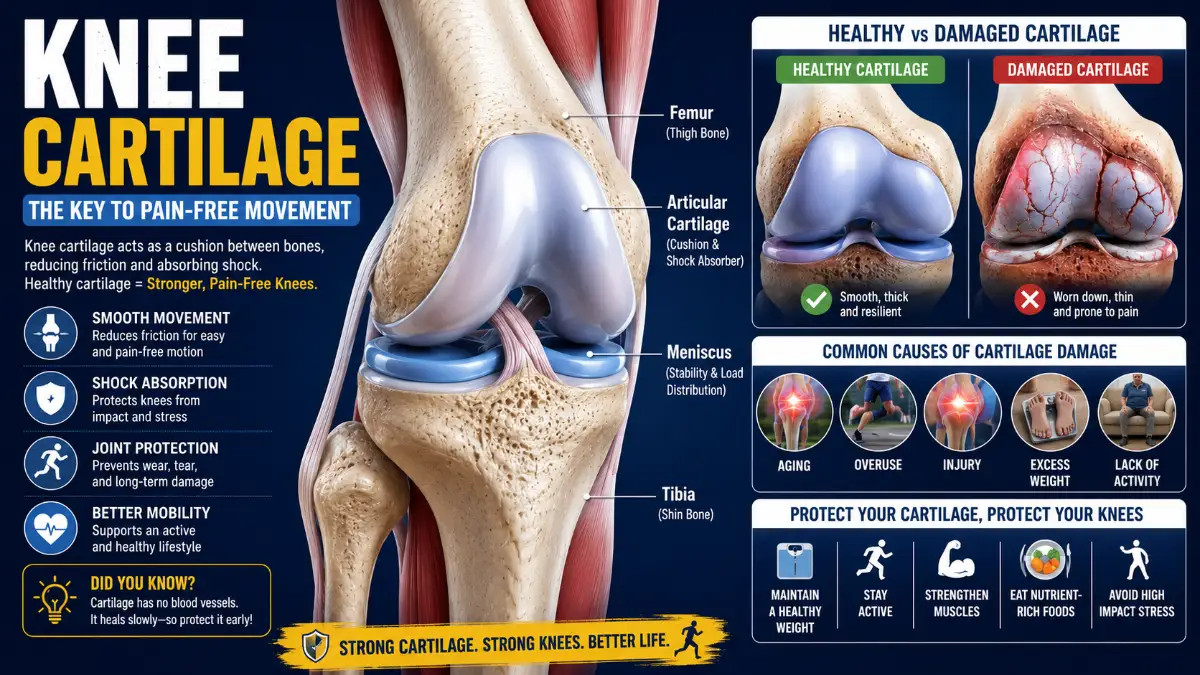
Knee cartilage is the smooth, resilient tissue that helps the knee move with minimal friction and distribute forces during walking, running, bending, climbing stairs, and other activities. The knee contains articular cartilage covering the joint surfaces and fibrocartilage forming the medial and lateral menisci.
Knee cartilage can be damaged by injury or affected by conditions such as osteoarthritis. Depending on the underlying problem, symptoms may include pain, swelling, stiffness, catching, reduced movement, and difficulty performing normal activities.
Cartilage damage does not automatically mean surgery is necessary. Many knee problems can initially be managed with appropriate exercise, rehabilitation, activity modification, weight management when relevant, medication, and other nonsurgical treatments. Selected focal cartilage defects may also be candidates for specialized cartilage-restoration procedures.
Knee Cartilage at a Glance
| Question | Quick answer |
| What is knee cartilage? | Cartilage helps create smooth joint movement and distribute loads through the knee. |
| What types are in the knee? | Articular cartilage covers joint surfaces, while fibrocartilage forms the menisci. |
| Can knee cartilage heal itself? | Adult articular cartilage has limited natural healing capacity. |
| Can knee cartilage grow back? | Extensive cartilage loss generally does not completely regenerate naturally. |
| Can exercise help? | Appropriate exercise can improve strength, mobility, function, and symptoms. |
| Does cartilage damage require surgery? | No. Many people begin with nonsurgical treatment. |
| Can supplements rebuild cartilage? | No supplement has been proven to completely restore extensively lost articular cartilage. |
What Is Knee Cartilage?
The term knee cartilage commonly refers to two different types of tissue inside the knee: articular cartilage and the fibrocartilage that forms the menisci.
Articular Cartilage
Articular cartilage is the smooth tissue covering the joint surfaces of the:
- Femur (thighbone)
- Tibia (shinbone)
- Patella (kneecap)
It creates a low-friction surface and helps distribute loads during movement.
Articular cartilage has limited intrinsic healing capacity after significant injury, which is one reason focal cartilage defects can be challenging to treat.
Also Read: Emergency Dentist: A Fast Action Plan for Tooth Pain, Swelling and Dental Injuries
Meniscal Cartilage
The knee contains two menisci:
- Medial meniscus on the inner side
- Lateral meniscus on the outer side
The menisci help distribute loads across the knee and contribute to joint stability.
A meniscus tear is therefore different from an articular cartilage defect, even though both structures are commonly described as cartilage.
Knee Cartilage Anatomy
The knee is formed primarily by the femur, tibia, and patella.
Articular cartilage covers the areas where these bones form joint surfaces. The medial and lateral menisci sit between the femur and tibia.
Together with ligaments, muscles, tendons, synovial fluid, and other tissues, these structures allow the knee to tolerate substantial loads while remaining mobile.
Articular Cartilage vs Meniscus
| Articular Cartilage | Meniscus |
| Covers joint surfaces | Sits between the femur and tibia |
| Provides a smooth, low-friction surface | Helps distribute loads |
| Has limited natural repair capacity | Healing potential varies with tear location |
| Can develop focal defects | Can develop traumatic or degenerative tears |
| Is affected during osteoarthritis | Can be damaged independently of osteoarthritis |
What Is Knee Cartilage Damage?
Knee cartilage damage occurs when cartilage becomes injured, disrupted, softened, cracked, thinned, or lost.
Damage can range from a small focal defect to extensive cartilage deterioration affecting a large part of the joint.
Cartilage may:
- Become softer or irregular
- Develop fissures
- Become thinner
- Develop a partial-thickness defect
- Develop a full-thickness defect
- Be lost over a broader joint surface
A focal cartilage injury in an otherwise healthy knee should not automatically be considered the same condition as widespread osteoarthritis.
What Causes Knee Cartilage Damage?
Several factors can affect knee cartilage.
Sports Injuries
Twisting, pivoting, landing, falling, and direct impact can injure structures within the knee.
Cartilage injuries may occur alongside:
- ACL injuries
- Meniscus tears
- Patellar dislocations
- Bone injuries
- Other ligament injuries
Osteoarthritis
Osteoarthritis is a whole-joint condition involving changes in cartilage, bone, synovium, and other joint tissues.
Articular cartilage can become thinner and more irregular as the condition progresses.
Previous Knee Injury
Previous ligament injuries, meniscus injuries, fractures, patellar instability, and other significant trauma can affect joint mechanics and may contribute to later problems.
Meniscus Damage
The menisci help distribute loads through the knee.
Significant meniscal injury or loss of meniscal tissue can alter the way forces are transmitted across joint surfaces.
Joint Alignment
Alignment influences how loads pass through different areas of the knee.
This can become particularly relevant when specialists evaluate selected patients for joint-preservation or cartilage-restoration procedures.
Symptoms of Knee Cartilage Damage
Possible symptoms include:
- Knee pain
- Swelling
- Stiffness
- Reduced range of motion
- Catching
- Clicking
- Grinding sensations
- Difficulty squatting
- Pain when climbing stairs
- Reduced exercise tolerance
- Difficulty returning to sport
These symptoms are not specific to cartilage damage.
Clicking, for example, does not automatically mean cartilage is injured.
What Does Knee Cartilage Pain Feel Like?
There is no single type of pain that confirms cartilage damage.
Some people describe:
- Deep aching pain
- Pain during weight-bearing
- Pain around or behind the kneecap
- Pain during stairs or squatting
- Joint-line discomfort
- Stiffness after inactivity
Pain severity and structural cartilage damage do not always correspond directly.
A proper diagnosis should therefore consider symptoms, examination findings, and imaging when appropriate.
Read More: Tubby Todd Review: Is This Baby Skincare Brand Actually Worth the Hype?
How Is Knee Cartilage Damage Diagnosed?
Diagnosis usually begins with a medical history and physical examination.
Physical Examination
A healthcare professional may evaluate:
- Range of motion
- Swelling
- Tenderness
- Muscle strength
- Knee stability
- Alignment
- Walking pattern
- Mechanical symptoms
X-Rays
Standard X-rays do not show cartilage directly in the same way they show bone.
They can, however, reveal findings associated with osteoarthritis and other joint problems, including joint-space narrowing, osteophytes, bone changes, and alignment abnormalities.
MRI
MRI can provide detailed images of:
- Articular cartilage
- Menisci
- Ligaments
- Tendons
- Bone
- Other soft tissues
MRI can help characterize suspected structural abnormalities when imaging is clinically appropriate.
Imaging results should be interpreted together with symptoms and examination findings.
Can Knee Cartilage Heal Itself?
Adult articular cartilage has limited intrinsic healing capacity.
One important reason is that articular cartilage lacks the rich blood supply found in many other tissues.
A substantial cartilage defect therefore does not simply heal in the same manner as a skin wound.
However, limited structural healing does not mean symptoms cannot improve.
Treatment can improve:
- Strength
- Mobility
- Physical capacity
- Joint function
- Pain management
- Ability to perform daily activities
without completely restoring the original cartilage structure.
The meniscus is different because portions of it have a better blood supply. Healing potential therefore varies according to the type and location of a meniscal tear.
Can Knee Cartilage Grow Back Naturally?
Extensively lost adult articular cartilage generally does not completely regenerate naturally.
This distinction is important because advertisements sometimes claim that a particular supplement, exercise, injection, or food can “regrow knee cartilage.”
There is no simple treatment proven to completely regenerate extensive cartilage loss in every patient.
Modern cartilage-restoration procedures can repair or replace selected focal defects, but that is different from naturally regrowing an entire cartilage surface affected by advanced arthritis.
Knee Cartilage Damage Grades
Cartilage injuries can be classified according to their depth and severity.
A simplified explanation is:
| Severity | General description |
| Mild | Surface softening or minor irregularity |
| Moderate | Partial-thickness cartilage damage |
| Severe | Deep cartilage defect |
| Full thickness | Cartilage loss extending to underlying bone |
The grade alone does not determine treatment.
Other considerations can include:
- Size
- Location
- Symptoms
- Age
- Activity goals
- Alignment
- Knee stability
- Meniscus condition
- Other injuries
- Presence of generalized osteoarthritis
How Is Knee Cartilage Damage Treated?
There is no universal treatment for damaged knee cartilage.
The appropriate approach depends on:
- The structure affected
- Cause of the damage
- Defect size and location
- Symptoms
- Knee alignment
- Stability
- Meniscus condition
- Activity level
- Overall joint health
For many people, treatment begins without surgery.
Nonsurgical Knee Cartilage Treatment
Exercise and Rehabilitation
Appropriate exercise is an important part of treatment for many knee conditions.
A rehabilitation program may focus on:
- Quadriceps strength
- Hamstring strength
- Gluteal strength
- Calf strength
- Hip control
- Balance
- Mobility
- Gradual return to normal activity
Exercise should be progressed according to symptoms and physical capacity.
Activity Modification
Activity modification does not necessarily mean complete rest.
Someone who temporarily struggles with high-impact exercise may be able to use alternatives such as cycling, swimming, or walking within tolerance while gradually rebuilding capacity.
Weight Management
For people who are overweight and have symptomatic knee osteoarthritis, sustainable weight reduction may improve symptoms and reduce mechanical loading.
Weight is only one factor affecting knee health and should not be presented as the sole cause of cartilage problems.
Read More: Smith Machine: Proper Form, Muscles Worked, and Workout Plans for Every Level
Best Exercises and Activities for Knee Cartilage
No exercise has been proven to simply rebuild extensively lost cartilage.
The goal of exercise is usually to improve strength, mobility, function, fitness, and load tolerance.
1. Quadriceps Contraction
Sit or lie with your leg straight.
Tighten the muscle at the front of the thigh, hold briefly, and relax.
Purpose: Quadriceps activation.
2. Straight-Leg Raise
Lie on your back with one knee bent.
Keep the opposite leg straight, tighten the thigh muscle, and slowly raise the leg.
Lower with control.
Purpose: Quadriceps strengthening.
3. Sit-to-Stand
Sit on a stable chair.
Stand using a controlled movement and slowly sit back down.
Purpose: Functional lower-body strengthening.
4. Glute Bridge
Lie on your back with your knees bent.
Raise your hips while keeping your trunk controlled.
Slowly lower.
Purpose: Gluteal and posterior-chain strengthening.
5. Step-Up
Use a low, stable step.
Step up and down with controlled movement.
Purpose: Functional leg strength and control.
6. Calf Raise
Stand near a stable support.
Slowly rise onto your toes and lower again.
Purpose: Calf strengthening.
7. Stationary Cycling
Start with comfortable resistance and duration.
Progress gradually if tolerated.
Purpose: Cardiovascular conditioning with adjustable resistance.
Is Walking Good for Knee Cartilage?
Walking can be appropriate for many people with knee conditions.
It can help maintain:
- Physical activity
- Mobility
- Cardiovascular fitness
- Leg function
If long walks substantially worsen symptoms, temporarily reducing distance and gradually rebuilding tolerance may be more appropriate.
Is Swimming Good for Knee Cartilage?
Swimming and water-based exercise can be useful when land-based activities are uncomfortable.
Water buoyancy reduces weight-bearing loads while still allowing muscles and the cardiovascular system to work.
Can You Squat With Knee Cartilage Damage?
Cartilage damage does not automatically mean squatting must be permanently avoided.
Appropriate:
- Depth
- Resistance
- Repetitions
- Frequency
depend on symptoms, diagnosis, strength, and physical capacity.
A shallow bodyweight squat may be tolerated even when deeper or heavily loaded squatting is uncomfortable.
Can You Run With Damaged Knee Cartilage?
Some people can continue or eventually return to running, while others may need to modify impact activities.
Important factors include:
- Diagnosis
- Symptoms
- Defect location
- Extent of damage
- Muscle strength
- Knee stability
- Training history
- Previous surgery
Return to running after cartilage surgery should follow the rehabilitation plan provided by the treating surgical and rehabilitation team.
When Should Exercise Be Modified?
Exercise may need to be reduced or modified if it causes:
- Significant or progressively increasing pain
- Large increases in swelling
- New locking
- Instability
- Persistent worsening after activity
People recovering from knee surgery should follow their procedure-specific rehabilitation restrictions.
Medicines for Knee Cartilage Pain
Medication cannot replace missing cartilage, but it may help control symptoms associated with conditions such as osteoarthritis.
Options can include topical or oral pain-relief medications depending on the individual.
Nonsteroidal anti-inflammatory drugs (NSAIDs) can help some people but can also cause gastrointestinal, kidney, cardiovascular, and other adverse effects.
Medication choices should take individual medical history and other medicines into account.
Do Knee Injections Restore Cartilage?
Different knee injections have different purposes and levels of evidence.
They should not automatically be described as cartilage-regeneration treatments.
Corticosteroid Injections
Corticosteroid injections may provide temporary symptom relief for some people.
They do not replace missing articular cartilage.
Hyaluronic Acid
Hyaluronic acid injections are offered in some healthcare settings.
Evidence and guideline recommendations vary, and these injections should not be marketed as a proven method of regrowing lost cartilage.
Platelet-Rich Plasma (PRP)
PRP is prepared from a person’s own blood.
Research has investigated its potential role in knee conditions, but preparation techniques and treatment protocols vary.
It should not be described as a guaranteed method for regenerating lost cartilage.
Cell-Based Treatments
Research into cell-based cartilage repair continues.
Be cautious about commercial treatments promising guaranteed complete cartilage regeneration.
When Is Knee Cartilage Surgery Considered?
Surgery may be considered for selected people with symptomatic structural abnormalities, particularly when appropriate nonsurgical management has not produced sufficient improvement.
Factors can include:
- Defect size
- Defect depth
- Location
- Symptoms
- Age
- Activity goals
- Knee alignment
- Ligament stability
- Meniscus condition
- Previous surgery
- Presence of osteoarthritis
An abnormal MRI result alone does not determine whether surgery is necessary.
Types of Knee Cartilage Repair Surgery
Microfracture
Microfracture creates small openings in the bone beneath a cartilage defect to stimulate a repair response.
The repair tissue produced is not identical to normal native articular cartilage.
Osteochondral Autograft Transfer
Cartilage and underlying bone from another area of the patient’s joint can be transferred to an appropriate focal defect.
Osteochondral Allograft
Donor cartilage and underlying bone may be transplanted into selected larger defects.
Autologous Chondrocyte Implantation
Cartilage cells can be collected, expanded, and subsequently used to treat selected cartilage defects.
Matrix-induced autologous chondrocyte implantation (MACI) is one example of this approach.
Osteotomy
When alignment places excessive load on one part of the knee, an osteotomy can sometimes redistribute forces across the joint.
Cartilage Restoration vs Knee Replacement
These treatments address different clinical situations.
Cartilage Restoration
Cartilage-restoration procedures are generally considered for carefully selected focal defects in joints suitable for preservation.
Knee Replacement
Knee replacement is generally associated with more extensive joint disease and significant pain or functional limitation when appropriate nonsurgical treatment no longer provides sufficient relief.
A small focal cartilage defect should therefore not be treated as equivalent to advanced “bone-on-bone” osteoarthritis.
Recovery After Knee Cartilage Surgery
Recovery varies substantially according to the operation.
Rehabilitation may include:
- Protection of the repair
- Swelling management
- Appropriate range-of-motion exercises
- Muscle activation
- Progressive weight bearing
- Strength development
- Balance and movement training
- Return-to-running progression
- Sport-specific rehabilitation
Some cartilage-restoration procedures require many months of rehabilitation.
Return to high-impact sport can take considerably longer than return to ordinary daily activities.
Procedure-specific instructions from the treating surgeon and rehabilitation team should take priority over generic recovery timelines.
Foods for Knee Cartilage
There is no established diet that can rebuild extensively lost knee cartilage.
Instead, focus on an overall nutritious eating pattern that supports muscle, bone, and general health.
Examples include:
- Vegetables
- Fruits
- Whole grains
- Beans and lentils
- Nuts and seeds
- Fish
- Eggs
- Lean protein sources
- Healthy unsaturated fats
Adequate protein can also help maintain and develop muscle during rehabilitation.
Do Knee Cartilage Supplements Work?
Supplements should not be treated as substitutes for diagnosis, rehabilitation, or appropriate medical treatment.
Collagen
Collagen supplements are marketed for joint health, but taking collagen should not be equated with directly replacing lost knee cartilage.
Glucosamine and Chondroitin
Research findings for glucosamine and chondroitin have been mixed.
They have not been established as reliable treatments for completely restoring extensively lost articular cartilage.
People taking medications or managing health conditions should discuss regular supplement use with an appropriate healthcare professional.
How to Protect Knee Cartilage
No strategy can prevent every cartilage injury, but several habits can support knee function.
Stay Active
Regular appropriate physical activity supports muscle strength, mobility, fitness, and general health.
Strengthen Your Legs
Develop strength in the:
- Quadriceps
- Hamstrings
- Glutes
- Calves
Increase Training Gradually
Avoid sudden large increases in running distance, sporting volume, jumping, or resistance training.
Rehabilitate Significant Knee Injuries
Appropriate rehabilitation after ligament, meniscus, patellar, or bone injuries can help restore strength and function.
Pay Attention to Persistent Symptoms
Repeated swelling, instability, locking, or significant persistent pain should be assessed rather than repeatedly ignored.
Common Knee Cartilage Myths
Myth 1: Clicking Means Your Cartilage Is Damaged
Knees can click or make other noises for many reasons.
Noise alone does not establish a diagnosis of cartilage damage.
Myth 2: Exercise Always Wears Out Knee Cartilage
Appropriately selected exercise is an important component of treatment for many knee conditions.
Exercise type and dose should match the individual’s diagnosis and capacity.
Myth 3: Supplements Can Completely Rebuild Cartilage
No commonly available supplement has been proven to completely restore extensive articular cartilage loss.
Myth 4: Knee Cartilage Damage Always Requires Surgery
Many cartilage-related conditions can initially be managed without surgery.
Myth 5: An MRI Decides Whether You Need Surgery
Imaging is only one part of clinical decision-making.
Symptoms, examination findings, activity goals, alignment, stability, other injuries, and overall joint health also matter.
When Should You See a Doctor?
Consider arranging a medical assessment for persistent or worsening knee symptoms, particularly when they interfere with everyday activities.
Seek prompt medical care if:
- You cannot bear weight after a significant injury
- The knee appears deformed
- The knee becomes locked
- Severe swelling develops rapidly
- Severe pain follows significant trauma
- The knee becomes hot and markedly swollen
- Knee symptoms occur with fever or feeling significantly unwell
These symptoms can have causes other than cartilage damage and should not be self-diagnosed.
Frequently Asked Questions
What is knee cartilage?
Knee cartilage includes smooth articular cartilage covering joint surfaces and fibrocartilage forming the medial and lateral menisci. These structures help the knee move efficiently and distribute loads.
What are the symptoms of knee cartilage damage?
Possible symptoms include pain, swelling, stiffness, catching, reduced movement, and difficulty with physical activities. These symptoms can also be caused by other knee conditions.
Can damaged knee cartilage heal?
Adult articular cartilage has limited natural healing capacity. However, symptoms and function can often improve through appropriate treatment and rehabilitation.
Can knee cartilage grow back?
Extensive adult articular cartilage loss generally does not completely regenerate naturally. Specialized procedures can repair or restore selected focal defects.
What is the best exercise for knee cartilage?
There is no universal best exercise. Strengthening, walking, cycling, and aquatic exercise can all be appropriate depending on the diagnosis, symptoms, and individual capacity.
Is walking good for damaged knee cartilage?
Walking can be appropriate for many people. Distance and intensity should be adjusted according to symptoms and tolerance.
Does knee cartilage damage always require surgery?
No. Many people initially receive nonsurgical treatment. Surgery is generally reserved for selected structural problems or circumstances where it is otherwise clinically appropriate.
Can supplements regrow knee cartilage?
No commonly available supplement has been proven to completely regenerate extensive lost articular cartilage.
Can I exercise with damaged knee cartilage?
Many people can remain physically active, although the type and amount of exercise may need modification according to symptoms and diagnosis.
Does cartilage damage mean I need a knee replacement?
No. A localized cartilage defect and widespread advanced osteoarthritis are different conditions. Cartilage damage alone does not automatically mean joint replacement is required.
