
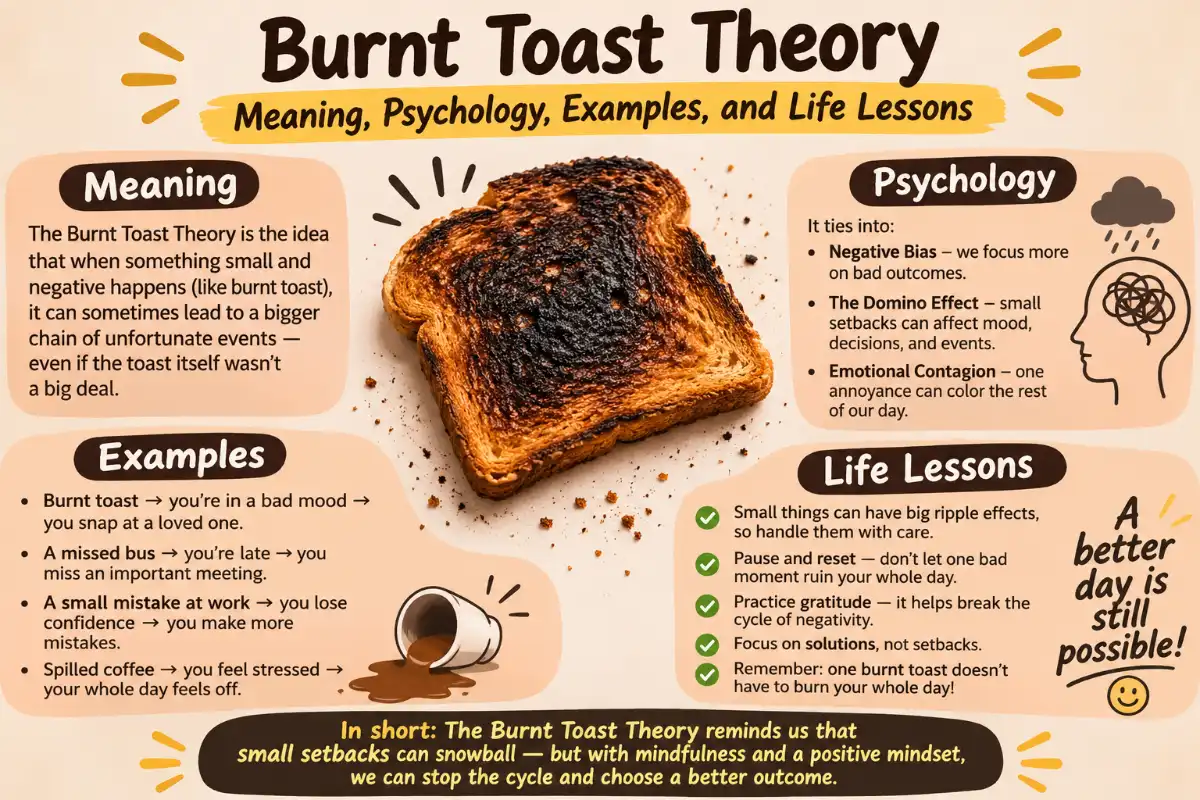
Little inconveniences can throw off your entire day. Burning breakfast, spilling coffee, missing the bus, or getting stuck in traffic might leave you frustrated and wondering what else could go wrong. But what if a small delay also created an opportunity you never expected?
The burnt toast theory suggests that everyday inconveniences can sometimes lead to surprisingly positive outcomes. Leaving home five minutes later than planned, for example, might mean running into an old friend or discovering a better route to work.
That doesn’t mean every setback happens for a reason. Instead, the idea encourages a more flexible outlook: one frustrating moment doesn’t have to shape the rest of your day.
What is the burnt toast theory?
The burnt toast theory is a popular social media concept suggesting that minor inconveniences can change the course of your day in ways you couldn’t have anticipated.
Imagine burning your toast before work. You spend a few extra minutes preparing breakfast again and leave home later than planned. Although the delay feels annoying, something pleasant or useful might happen afterward.
Some interpretations suggest that these unexpected delays could even protect you from something worse. However, there’s no scientific evidence that ordinary setbacks occur specifically to prevent future harm.
The more useful lesson is simpler: an inconvenience doesn’t automatically mean the rest of your day will go badly.
This perspective shares similarities with cognitive restructuring, a technique used in cognitive behavioral therapy (CBT) to examine and reconsider unhelpful thoughts. It doesn’t require you to ignore negative feelings. Instead, it encourages you to interpret difficult situations more realistically and respond constructively.
How to become more positive
Developing a healthier mindset doesn’t mean forcing yourself to feel happy all the time. It’s about learning to handle setbacks without immediately assuming the worst.
A few everyday habits can help:
- Recognize negative self-talk: Notice thoughts like “Nothing ever goes right for me” without judging yourself for having them.
- Practice balanced thinking: Replace extreme assumptions with more realistic alternatives, such as “This is frustrating, but I can still have a good day.”
- Practice gratitude: Appreciate small positive experiences, whether that’s a kind conversation, a quiet moment, or something you’ve accomplished.
- Accept uncertainty: Remember that not every inconvenience has an obvious explanation or a predictable outcome.
These habits can help you manage frustration without expecting every disappointing experience to turn into something wonderful.
How to Practise the Burnt Toast Theory in Daily Life
You don’t need to change your entire routine to apply the burnt toast theory. The goal is simply to respond more thoughtfully when something unexpected interrupts your plans.
- Pause before reacting. When something goes wrong, take a moment before deciding that your whole day is ruined.
- Acknowledge your emotions. Feeling disappointed, irritated, or anxious when plans change is completely normal.
- Consider another perspective. Ask yourself whether there’s another reasonable way to interpret the situation or a practical solution you haven’t considered.
- Focus on what you can control. Rather than searching for a hidden meaning, think about what you can do next.
- Reflect afterward. Consider whether the experience taught you something useful or opened up an unexpected opportunity.
For example, if you miss a train, checking the next departure will probably help more than spending the entire journey criticizing yourself.
You don’t have to believe the delay happened for a special reason to handle it constructively. This practical approach also aligns with the National Institute of Mental Health’s guidance on caring for your mental health, which emphasizes healthy coping habits and managing stress.
Is the Burnt Toast Theory Scientifically Proven?
No. The burnt toast theory isn’t an established scientific theory, and research hasn’t demonstrated that minor inconveniences happen to protect people from future problems.
However, the concept has some similarities to ideas found in psychology and mathematics.
Cognitive reframing involves reconsidering how you interpret an experience. Instead of treating one frustrating event as evidence that everything is going wrong, you look for a more balanced explanation. This is consistent with the principles of cognitive behavioral therapy described by the American Psychological Association.
The butterfly effect, associated with chaos theory, describes how small differences in initial conditions can sometimes lead to substantially different outcomes in certain complex systems. The broader scientific concept is discussed in Encyclopaedia Britannica’s explanation of chaos theory.
These ideas shouldn’t be confused with one another. The butterfly effect doesn’t prove that missed buses, burnt breakfasts, or other inconveniences happen for a predetermined purpose.
Ultimately, the burnt toast theory is better understood as a popular mindset metaphor than a scientific explanation for life’s events.
Finding silver linings
Finding a silver lining means recognizing that an unpleasant experience might also have something useful or positive about it.
It doesn’t mean pretending the original problem was a good thing.
A canceled plan, for instance, may leave you disappointed but give you an opportunity to rest. A delayed appointment might be inconvenient while leaving you time to finish another task.
You can look for silver linings by:
- Accepting that the situation is frustrating.
- Allowing yourself to feel disappointed without guilt.
- Considering whether anything useful came from the experience.
- Recognizing that positive and negative feelings can exist at the same time.
Sometimes you’ll notice an unexpected benefit. Other times, you’ll simply need to deal with an inconvenience.
Both experiences are normal, and neither requires you to manufacture a positive explanation.
Is the Burnt Toast Theory Real?
The burnt toast theory is real as a popular social media idea, but it isn’t a scientifically proven rule about how life works.
The concept gained attention on platforms such as TikTok, where people shared stories about seemingly unfortunate delays that appeared to lead to lucky outcomes.
There’s a reasonable observation behind these stories: small changes in our schedules, decisions, and interactions can influence what happens later.
However, people tend to remember striking coincidences more readily than ordinary events. This tendency is related to confirmation bias, which involves favoring information that supports existing beliefs.
Someone might vividly remember missing a bus and unexpectedly meeting a friend, for example, while forgetting the many times a missed bus simply made them late.
Such experiences can still feel meaningful. They just don’t establish that an invisible force arranged the circumstances.
Real-Life Examples of the Burnt Toast Theory
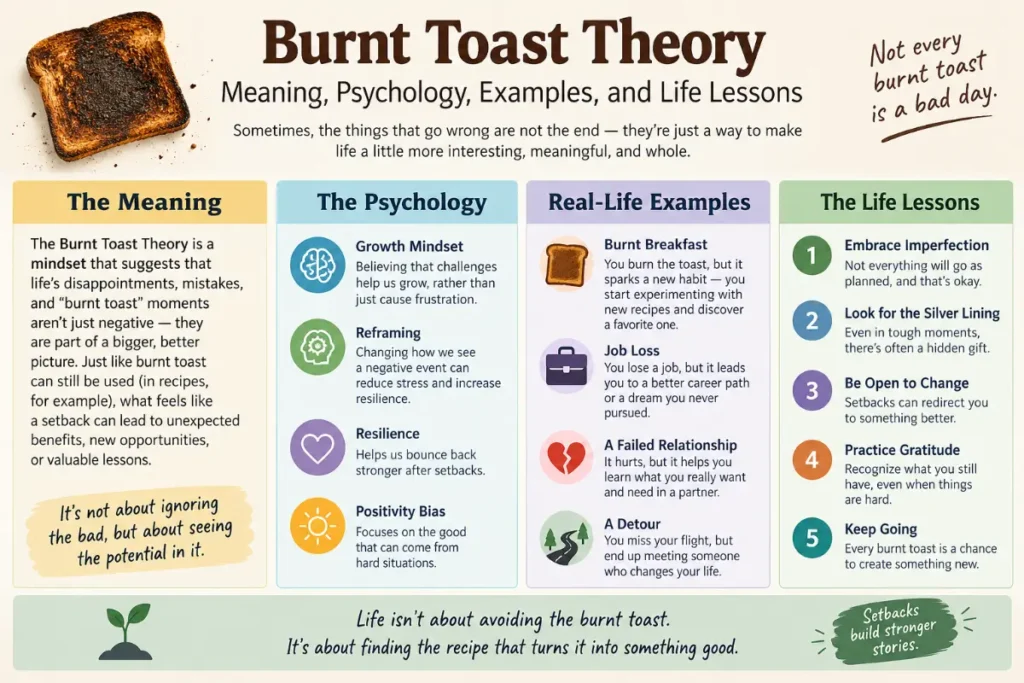
The burnt toast theory can help you reconsider everyday situations without dismissing the frustration they cause.
| Situation | Initial negative reaction | A healthier perspective |
| Burning your breakfast | “My day is ruined.” | “I can make something else and move on.” |
| Missing the bus | “Everything is going wrong.” | “I can check another route or departure.” |
| Losing a job opportunity | “I’ll never succeed.” | “I can learn from the experience and explore other opportunities.” |
| A canceled plan | “My time has been wasted.” | “I can rest or use the time differently.” |
| Taking a wrong turn | “I can’t do anything right.” | “I can correct my route and continue.” |
Consider a job rejection. After spending time preparing for an interview, hearing that you didn’t get the position can be genuinely discouraging.
Later, you might identify ways to improve your interview skills or find another position that better suits your interests and experience.
That doesn’t mean the rejection was necessary or ultimately beneficial. It simply shows that one disappointing experience doesn’t rule out future opportunities.
Burnt Toast Theory vs Toxic Positivity
The burnt toast theory and toxic positivity can sound similar because both involve looking for positive outcomes. However, there’s an important difference.
A balanced interpretation of the burnt toast theory allows you to acknowledge disappointment while remaining open to other possibilities.
Toxic positivity, on the other hand, involves excessive pressure to maintain a positive attitude, even when someone is experiencing genuine emotional distress.
| Burnt Toast Theory | Toxic Positivity |
| Encourages considering another perspective. | Pressures people to remain positive. |
| Allows disappointment and frustration. | May dismiss uncomfortable emotions. |
| Accepts uncertain outcomes. | Can imply everything must turn out well. |
| Encourages flexibility and reflection. | May discourage honest discussions about problems. |
For example, telling someone who has lost their job that they should immediately feel grateful for a new opportunity can overlook their financial worries and emotional distress.
A more supportive response acknowledges how difficult the experience is while leaving room for other possibilities to emerge over time.
You don’t need to find a positive explanation for grief, financial hardship, illness, or other serious experiences. Recognizing difficult emotions is an important part of healthy coping, as reflected in the National Institute of Mental Health’s guidance on managing stress and anxiety.
The most useful interpretation of the burnt toast theory makes room for both hope and honest emotions.
Conclusion
The burnt toast theory offers a simple reminder that small inconveniences don’t necessarily determine what happens next.
Burning breakfast, missing transportation, or dealing with canceled plans can be frustrating. Sometimes these situations create unexpected opportunities. Other times, they’re simply problems that require practical solutions.
The real value of the idea lies in staying flexible, acknowledging your emotions, and remembering that one difficult moment doesn’t mean the entire day will go badly.
Read also: Healthy Cereal: Best Choices, Nutrition Facts, and Buying Tips
Frequently Asked Questions
Does the burnt toast theory mean everything happens for a reason?
Not necessarily. Some people interpret it that way, but the theory doesn’t establish that events have a predetermined purpose. A more practical interpretation is that unexpected setbacks can sometimes lead to opportunities, even when their outcomes are uncertain.
Is the burnt toast theory a psychological concept?
It’s a popular mindset concept rather than an established psychological theory. However, its emphasis on reconsidering negative situations shares similarities with cognitive reframing, a technique associated with cognitive behavioral therapy.
Can the burnt toast theory help with anxiety?
It may encourage a more balanced response to minor frustrations, but it isn’t a proven treatment for anxiety. People experiencing persistent or disruptive anxiety may benefit from professional mental health support.
