
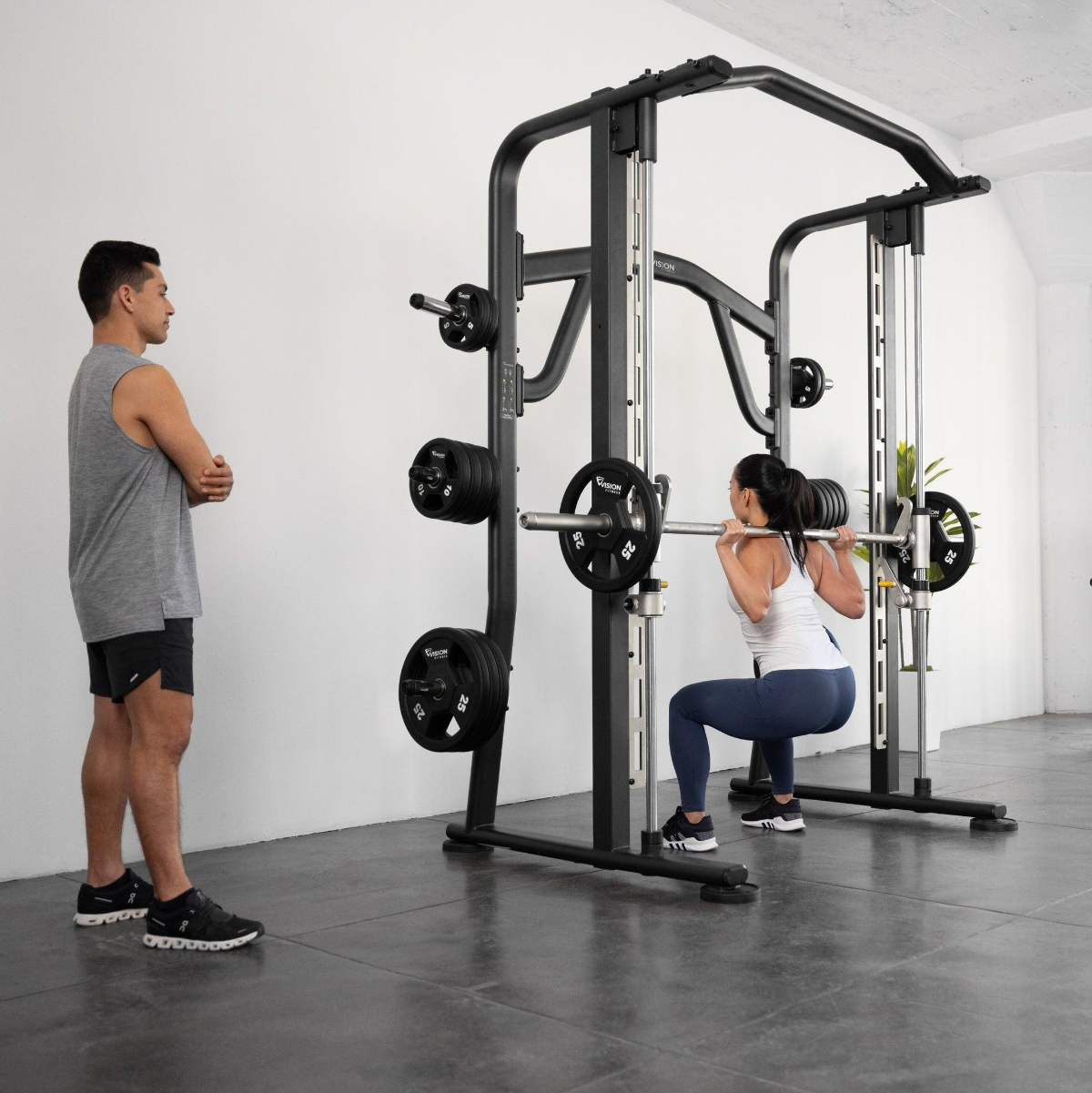
Most lifters either avoid the smith machine because they’ve heard it’s inferior, or they use it without ever refining their technique past the basics. Both approaches leave results on the table. This equipment rewards deliberate skill progression-the more precisely you dial in setup and execution, the more it delivers.
Smith Machine: Quick Answer
- What it is: A barbell locked onto vertical or angled rails, moving through a fixed path with safety hooks that let you lift without a spotter.
- Is it effective? Yes-research shows comparable muscle growth to free weights when volume and effort are matched.
- Who should use it: Beginners learning form, solo lifters, anyone training for hypertrophy or controlled failure sets.
- Who should avoid it as a primary tool: Powerlifters or athletes needing free-barbell strength transfer or stabilizer development.
- Biggest mistake: Standing directly under the bar during squats instead of positioning feet forward of the rail, which increases knee stress.
How to Use a Smith Machine Correctly
To use a smith machine correctly: set the safety catches, position the bar height, align your body, unlock the bar, perform the rep, then re-rack it securely.
- Set the safety catches just below your lowest range of motion.
- Set the bar height-shoulder level for squats, chest level for bench press, hip level for rows.
- Position your body-feet forward of the rail for squats, bench centered under the bar for presses.
- Unlock the bar by rotating your wrists forward.
- Perform the rep under control, without bouncing or using momentum.
- Re-rack the bar by rotating your wrists backward, and confirm it’s locked before letting go.
Also Read: Bonefish Grill
Understanding the Equipment
A smith machine holds a barbell within steel guide rails, forcing it to travel along a fixed vertical or slightly angled plane rather than moving freely through space. Safety hooks positioned along the rail catch the bar automatically, and a wrist-rotation motion locks or releases it.
Two rail designs exist in gyms today:
- A straight-vertical rail keeps the bar moving in a perfectly linear path.
- A linear-converging rail angles slightly, following a diagonal that better matches the natural arc of a human squat or press, typically reducing stress on the knees and shoulders compared to a purely vertical track.
The bar itself is usually counterbalanced through an internal cable-and-pulley system, meaning an unloaded bar can require as little as 4–9kg of actual lifting effort rather than the 20kg of a standard Olympic barbell. This figure differs across manufacturers, so check your gym’s specific equipment rather than estimating.
Benefits and Drawbacks at a Glance
| Benefits | Drawbacks |
| Built-in safety-catch hooks function as an automatic spotter | Reduced stabilizer and core engagement compared to free weights |
| Muscle isolation-the fixed path lowers stabilizer demand, focusing effort on the target muscle | Strength gains are largely equipment-specific and don’t fully transfer to free-barbell performance |
| Comparable hypertrophy to free weights when volume and effort match | Joint stress risk if stance or bench setup doesn’t match your proportions |
| Easier to train to true muscular failure without a partner | Bar weight confusion-the counterbalance system makes it easy to misjudge true load |
| Efficient for home gyms-covers squats, presses, and rows in a small footprint | Limited value for athletic or competition-specific training requiring free-barbell skill |
Common Smith Machine Mistakes
- Standing too close to the bar during squats, which forces the knees forward and increases joint shear.
- Locking out knees or elbows at the top of a rep instead of maintaining a slight bend.
- Incorrect bench alignment, positioning it too far forward or back relative to the bar’s fixed path, causing shoulder discomfort.
- Using too much weight before mastering form, especially common since the safety catches create a false sense of security.
- Skipping the safety-stop adjustment entirely, which removes the equipment’s core safety advantage.
- Rushing the re-rack step, which is when most injuries on this equipment actually happen.
The Three Levels of Smith Machine Competency
| Level | Focus | Progress Signal |
| Foundation | Safety setup, bar height, basic rep execution | Complete a full set with consistent form, no hesitation unlocking or re-racking |
| Precision | Adjusting stance and bench position to your proportions | Joint discomfort resolved through fine-tuned foot or bench placement |
| Application | Using the fixed path for failure training, drop sets, and programming decisions | You know when to choose a smith machine versus free weights for a specific goal |
Fitting the Machine to Your Body
Your ideal stance distance from the rail depends on your limb proportions. Lifters with proportionally longer legs typically need to stand 10–12 inches in front of the bar’s vertical line so their hips can travel back without excessive torso lean. Lifters with shorter legs relative to their torso often find 6–8 inches sufficient.
For bench press, center the bench so the bar’s downward path lands at mid-chest. Pinching at the front of the shoulder during the descent usually means the bench sits too far forward relative to the fixed rail.
What Research Says About Muscle Growth and Strength
A 2023 meta-analysis pooling multiple trials found no statistically significant difference in hypertrophy outcomes between machine-based and free-weight resistance training when volume and effort were matched.
Strength tells a more specific story. A systematic review found that free-weight training produced greater strength improvements when tested on free-weight lifts, while machine-based training produced greater gains when tested on machine-based lifts. Strength adaptations are largely tied to the equipment you actually train on-a strong smith machine squat doesn’t guarantee an equally strong free-barbell squat, and vice versa.
Read More: Supplementary Angles
Smith Machine vs Free Weights vs Squat Rack
| Factor | Smith Machine | Free Weights | Squat Rack |
| Muscle growth | Comparable with matched volume | Comparable with matched volume | Comparable with matched volume |
| Strength transfer | Specific to the fixed-path pattern | Specific to free-barbell movement | Direct transfer to free-barbell strength |
| Solo safety | High-built-in safety catches | Lower for heavy sets without a spotter | Moderate-safety pins help, but a spotter is still recommended for max attempts |
| Stabilizer demand | Minimal | Significant | Significant |
| Best use case | Isolation work, failure sets | Compound lifts, skill-specific practice | Heavy squats and presses with free-bar mechanics |
Muscles Worked and Best Exercises
The smith machine trains nearly every major muscle group. Because the bar path is fixed, these exercises reduce demand on stabilizer muscles compared to their free-weight equivalents, letting you concentrate effort on the target muscle through its full range of motion.
| Exercise | Muscles Worked | Setup Cue |
| Back squat | Quadriceps, glutes | Feet forward of the rail based on your proportions |
| Romanian deadlift | Hamstrings, glutes | Bar at hip height, minimal knee bend, hinge from the hips |
| Hip thrust | Glutes | Upper back braced on a bench, bar padded across the hips |
| Flat bench press | Chest, triceps | Bar lowers to mid-chest, grip slightly wider than shoulders |
| Seated overhead press | Shoulders, triceps | Bar starts at collarbone height |
| Bent-over row | Back, lats | Bar set low, hinge at the hips |
| Standing calf raise | Calves | Balls of feet elevated on a platform |
Smith Machine Workout Plan for Beginners
- Squat – 3 sets x 10 reps
- Bench Press – 3 sets x 10 reps
- Row – 3 sets x 10 reps
- Shoulder Press – 3 sets x 12 reps
- Calf Raise – 3 sets x 15 reps
Rest 45–60 seconds between sets, and warm up with an unloaded bar to rehearse each movement pattern before adding weight.
Building a Progressive Workout Plan
Building Consistency (Months 2–6)
Shift to a four-to-five-day push/pull/legs split, working in the 8–12 rep range. Add Romanian deadlifts, hip thrusts, and incline press variations to broaden muscle coverage, and apply progressive overload weekly by increasing either load or reps.
Advanced Programming (6+ Months of Consistent Training)
Incorporate mechanical drop sets on pressing movements and partial-range overload sets on calves and shrugs. Sequence free-weight compound lifts earlier in the session, reserving smith machine work for isolation exercises or failure-focused finishing sets later in the workout.
Best Smith Machine for a Home Gym
For long-term joint comfort, a linear-converging (angled) rail generally outperforms a purely vertical track, since it more closely follows a free barbell’s natural range of motion. Verify the counterbalance mechanism and actual bar weight rather than assuming it matches a standard 20kg barbell, and prioritize safety catches with fine adjustment increments. Weight capacity should comfortably exceed your current working loads to accommodate future progress. Because pricing and specific models change frequently, check current retailer listings and verified buyer reviews rather than relying on outdated buying guides.
Where This Leaves You
Competency with a smith machine is a progression: safe setup, personalized positioning, then deliberate application within a broader training plan. Muscle growth on this equipment matches free weights when effort and volume are equal, but strength built here stays largely specific to the fixed path-pair it with free-weight training if functional or competition-specific strength matters to you. For further reading, explore guides on squat form, bench press technique, hypertrophy training principles, and progressive overload.
Frequently Asked Questions
Why does the smith machine feel easier than free weights?
It feels easier mainly because the fixed rail removes the need for balance and stabilizer engagement, letting you focus entirely on the target muscle. The bar is also often counterbalanced, meaning it lifts lighter than its labeled weight, which can add to the sensation of reduced effort even at the same working load.
Is using a smith machine cheating?
No-this is a common misconception. Muscle growth depends primarily on mechanical tension applied to the muscle, and research shows no significant hypertrophy difference between machine-based and free-weight training when volume and effort are matched. The perception of “cheating” comes from reduced stabilizer demand, not from any shortcut in muscle-building effectiveness.
How do I know if I’m using too much weight too soon?
If your form breaks down mid-set-knees caving inward, torso rounding, or the bar path drifting off-center-you’ve exceeded your current capacity. Reduce the load until every rep in a set looks identical from first to last, then progress gradually.
Can a smith machine replace a squat rack in a home gym?
It can cover more movement variety in a smaller footprint, including squats, presses, and rows. However, it can’t fully replace a squat rack for lifters specifically training free-barbell squats and deadlifts, since those movements need an unrestricted bar path that a fixed-rail machine doesn’t provide.
Does rep tempo matter more on a smith machine than with free weights?
Yes, in a specific way-the fixed path removes the natural instability that often forces slower, controlled reps with free weights. Deliberately slowing your descent and avoiding any bounce at the bottom of a rep helps maintain the same training stimulus you’d get from a free barbell.
