
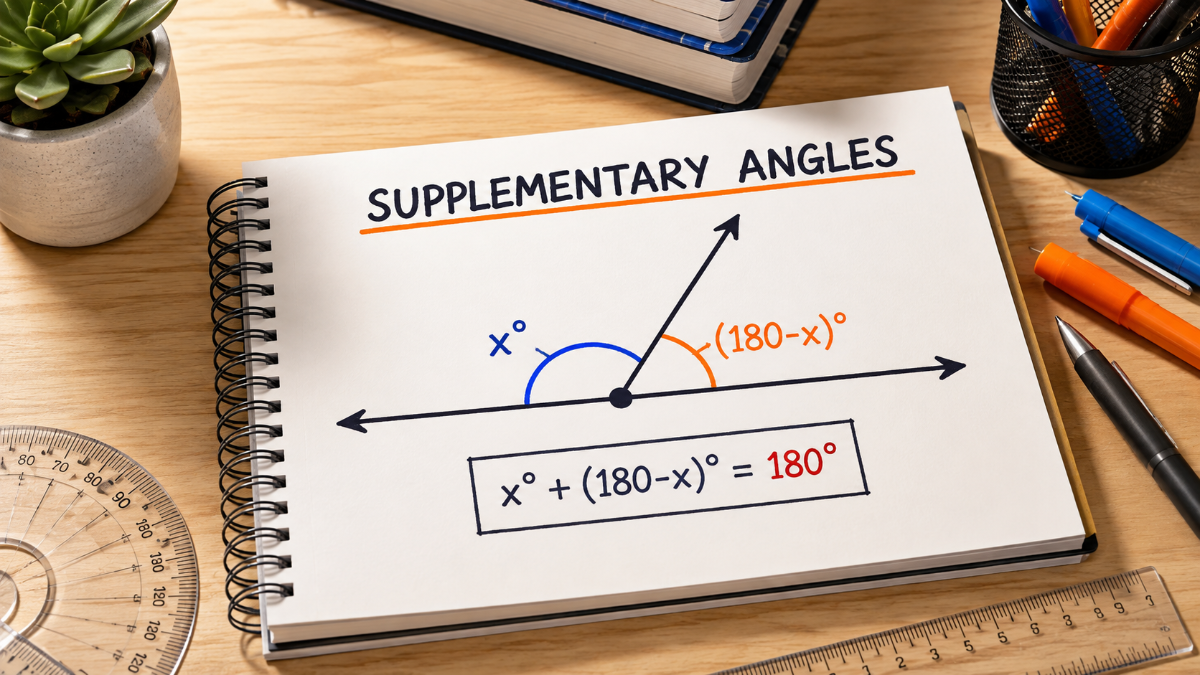
Supplementary angles are two angles whose measures add up to 180°. The formula is straightforward: if m∠A + m∠B = 180°, then ∠A and ∠B are supplementary, and each is called the other’s supplement. For example, 70° and 110° are supplementary because 70 + 110 = 180.
This guide takes a problem-first approach to supplementary angles. It shows how to recognize them in a diagram, calculate them accurately, and apply the concept to parallel lines, polygons, algebra, and geometric proofs-with worked problems ordered from beginner to advanced.
The Core Rule: What Makes Angles Supplementary
Two angles are supplementary whenever their measures together total 180°. This has nothing to do with where the angles are drawn. A supplementary pair might sit side by side and visibly form a straight line, or they might belong to two entirely separate shapes on opposite ends of a page. The only test that matters is arithmetic: does the sum equal 180°?
Also Read: Generation Genius
A few quick examples:
- 100° and 80° are supplementary (100 + 80 = 180)
- 155° and 25° are supplementary (155 + 25 = 180)
- 90° and 90° are supplementary (90 + 90 = 180)
Two Properties Every Student Should Know
1. The sum is fixed at 180°, with no exceptions. If two angle measures don’t total exactly 180°, the pair simply isn’t supplementary-even if they’re close.
2. Position is optional, but a shared straight line is common. When two supplementary angles happen to share a vertex and a side, with their outer arms pointing in opposite directions, they form what’s called a linear pair-the case most people picture first. The mathematical definition, however, never requires this adjacency, non-adjacent angles in unrelated figures can be supplementary too, as long as their measures sum to 180°.
Supplementary Angles Formula and How to Use It
Formula: Supplement of angle A = 180° − m∠A
This one-line formula is all you need to find a missing angle once you know its partner. Here’s how it looks across a range of values:
| If One Angle Measures | The Supplement Is | Verification |
| 15° | 165° | 15 + 165 = 180 |
| 48° | 132° | 48 + 132 = 180 |
| 90° | 90° | 90 + 90 = 180 |
| 101° | 79° | 101 + 79 = 180 |
| 167° | 13° | 167 + 13 = 180 |
A Simple 3-Step Method for Any Problem
- Identify what’s given-is it a numeric angle, or an algebraic expression like (2x + 10)°?
- Write the supplementary equation-set the sum of the two angle expressions equal to 180°.
- Solve and verify-substitute your answer back in and confirm the two measures genuinely sum to 180°.
Complementary and Supplementary Angles: A Side-by-Side Breakdown
Students frequently mix up complementary and supplementary angles because both describe a fixed-sum relationship. Here’s a direct comparison.
| Question | Complementary Angles | Supplementary Angles |
| What do they add up to? | 90° | 180° |
| What shape do they create (if adjacent)? | A right angle (square corner) | A straight line |
| Formula for the missing angle | 90° − known angle | 180° − known angle |
| Example | 55° + 35° = 90° | 55° + 125° = 180° |
| Common memory cue | “Completing a corner” | “Completing a straight line” |
That last row is a recall trick, not a claim about what the words themselves mean mathematically-it simply helps some learners remember which sum belongs to which term.
Recognizing a Linear Pair on a Straight Line
When two adjacent angles sit along a straight line-meaning a single ray splits the line into two sections-those two angles are automatically supplementary. This special case is known as a linear pair.
The direction of this logic matters: every linear pair is supplementary, but not every supplementary pair is a linear pair. A linear pair is the stricter condition-it requires adjacency and a shared straight line-while the broader relationship only requires the 180° sum, regardless of position.
Vertical Angles and Their Supplementary Neighbors
When two straight lines cross, they create two pairs of vertical angles-the angles directly opposite each other at the intersection point. Vertical angles are always equal to one another, never supplementary. However, each vertical angle sits next to two other angles at that same intersection, and each of those adjacent angles forms a linear pair with it.
This means that at any single intersection of two lines, you get four angles total: two pairs of equal vertical angles, and four separate linear pairs connecting the adjacent angles around the intersection point. Recognizing this layout helps solve problems where only one angle is given, since you can find all four surrounding angles using just two rules-vertical angles are equal, and adjacent angles are supplementary.
How Supplementary Angles Appear With a Transversal
When a transversal cuts across two parallel lines, two angle pairs are consistently supplementary:
- Co-interior angles (also called same-side interior angles): positioned between the two parallel lines, on the same side of the transversal.
- Co-exterior angles (same-side exterior angles): positioned outside the two parallel lines, on the same side of the transversal.
By contrast, when the same transversal cuts two parallel lines, corresponding angles and alternate interior angles are congruent (equal), not supplementary. These equality and supplement relationships specifically depend on the two lines being parallel-if the lines aren’t parallel, none of these standard pairings are guaranteed to hold.
Converse application: If a transversal crosses two lines and a pair of co-interior angles sums to 180°, that alone proves the two lines are parallel-a technique frequently used in coordinate and Euclidean geometry proofs.
The Congruent Supplements Rule
If two angles are each supplementary to the same angle, those two angles must be equal to each other.
Symbolically: if m∠P + m∠R = 180° and m∠Q + m∠R = 180°, then m∠P = m∠Q.
This shortcut avoids the need to measure ∠P and ∠Q directly-instead, you only need to confirm that both share a supplementary relationship with the same reference angle ∠R. It’s a standard technique in formal geometric proofs.
Supplementary Angles and a Triangle’s Exterior Angle
An interior angle of a triangle and its adjacent exterior angle always form a linear pair, meaning they are supplementary and sum to 180°. This relationship is a fast way to calculate an exterior angle: simply subtract the known interior angle from 180°.
Worth noting: a triangle’s three interior angles already sum to 180° on their own. Two interior angles of the same triangle generally aren’t supplementary to each other-the relationship here specifically involves an interior angle and its neighboring exterior angle, not two interior angles.
Read More: Hertz Car Sales
Supplementary Angles Inside Parallelograms
Quadrilaterals offer another practical setting for this relationship. In any parallelogram, consecutive angles-meaning two angles that share a side-are always supplementary, summing to 180°. This happens because each pair of consecutive angles behaves like co-interior angles formed by a transversal (one of the parallelogram’s sides) cutting across the two parallel sides.
For example, if one angle of a parallelogram measures 65°, the two angles adjacent to it must each measure 115° (180° − 65°), while the angle opposite the original 65° angle remains 65° as well, since opposite angles in a parallelogram are always equal. This property is frequently tested in problems asking students to find all four angles of a parallelogram from a single given value.
Worked Problems: From Basic to Advanced
Problem 1-Direct Substitution
Find the supplement of 73°.
Solution: 180° − 73° = 107°
Problem 2-Solving a Linear Pair Equation
Two angles forming a linear pair measure (4x + 20)° and (x + 40)°. Find x and both angle measures.
- Set up the equation: (4x + 20) + (x + 40) = 180.
- Combine like terms: 5x + 60 = 180.
- Subtract 60: 5x = 120.
- Divide by 5: x = 24.
- Substitute back: first angle = 4(24) + 20 = 116°, second angle = 24 + 40 = 64°.
Answer: x = 24, with angles measuring 116° and 64° (116 + 64 = 180 ✓).
Problem 3-Co-Interior Angles
A transversal crosses two parallel lines. One co-interior angle measures 98°. Find its pair.
Solution: 180° − 98° = 82°
Problem 4-Applying the Congruent Supplements Rule
∠M and ∠N are each supplementary to ∠K. ∠M = (3x + 10)° and ∠N = (5x − 30)°. Find x and confirm ∠M = ∠N.
- Since both are supplementary to ∠K, ∠M = ∠N by the theorem.
- Set the expressions equal: 3x + 10 = 5x − 30.
- Rearrange: 40 = 2x.
- Divide by 2: x = 20.
- Substitute back: ∠M = 3(20) + 10 = 70°, ∠N = 5(20) − 30 = 70°.
Answer: x = 20, and ∠M = ∠N = 70°.
Problem 5-A Word-Based Algebra Challenge
An angle’s supplement is 20° less than three times the angle. Find the angle.
- Let the angle be x. Its supplement is 180° − x.
- Set up: 180 − x = 3x − 20.
- Add x to both sides: 180 = 4x − 20.
- Add 20: 200 = 4x.
- Divide by 4: x = 50°.
Answer: The angle measures 50°, and its supplement is 130° (50 + 130 = 180 ✓).
Problem 6-Consecutive Angles in a Parallelogram
One angle of a parallelogram measures (2x + 10)°, and the consecutive angle measures (3x − 30)°. Find x and both angle measures.
- Consecutive angles in a parallelogram are supplementary: (2x + 10) + (3x − 30) = 180.
- Combine like terms: 5x − 20 = 180.
- Add 20: 5x = 200.
- Divide by 5: x = 40.
- Substitute back: first angle = 2(40) + 10 = 90°, second angle = 3(40) − 30 = 90°.
Answer: x = 40, and both consecutive angles measure 90° (90 + 90 = 180 ✓), meaning this particular parallelogram is a rectangle.
Practice Problems
Solve these on your own, then check the answer key below.
- Find the supplement of 84°.
- Two angles forming a linear pair measure (3x + 12)° and (2x + 8)°. Find x.
- A transversal crosses two parallel lines, and one co-interior angle measures 121°. Find the other.
- One angle of a parallelogram measures 72°. Find the measure of its two consecutive angles.
Answer key: (1) 180° − 84° = 96°. (2) 3x + 12 + 2x + 8 = 180 → 5x + 20 = 180 → 5x = 160 → x = 32. (3) 180° − 121° = 59°. (4) 180° − 72° = 108° each.
Where Students Go Wrong
- Treating “adjacent” as a requirement: Supplementary angles never need to touch-only their sum matters.
- Ignoring the parallel-lines condition: Co-interior, co-exterior, corresponding, and alternate interior angle relationships only hold when the transversal crosses lines that are actually parallel.
- Confusing co-interior angles with corresponding angles: In a parallel-lines diagram, only co-interior and co-exterior angle pairs are supplementary, corresponding and alternate interior angles are equal instead.
- Mixing up vertical and supplementary angles: Vertical angles formed by two intersecting lines are always equal, not supplementary-it’s the angles adjacent to them that are supplementary.
- Skipping verification: Always add your two final answers together to confirm the 180° total before finalizing a solution.
Frequently Asked Questions
Is there a difference between “supplementary” and “supplement” in geometry?
“Supplementary” describes the relationship between two angles, while “supplement” refers to one specific angle relative to its partner. In the pair 60° and 120°, the two angles are supplementary, and 120° is the supplement of 60° (and vice versa).
Can a triangle contain two supplementary interior angles?
Generally no, because a triangle’s three interior angles always total 180° on their own. If two interior angles summed to 180°, the third would have to measure 0°, which isn’t a valid triangle. Supplementary relationships involving a triangle typically occur between an interior angle and its adjacent exterior angle, not between two interior angles.
How do supplementary angles relate to a triangle’s exterior angle?
An interior angle of a triangle and its adjacent exterior angle form a linear pair, so they are always supplementary and sum to 180°. Subtracting the known interior angle from 180° gives the exterior angle directly.
What’s a fast way to check if a diagram shows supplementary angles?
Look for two angles positioned along a straight line, or check whether the problem states the angles are co-interior or co-exterior angles formed by a transversal crossing parallel lines. If neither cue applies, add the two given numeric measures directly-if they total 180°, the angles are supplementary regardless of their position in the diagram.
Do coordinate geometry problems ever require supplementary angle reasoning?
Yes. When two lines intersect on a coordinate plane, the angles formed at that intersection point follow the same supplementary and vertical angle rules as angles in a standard diagram. Confirming that adjacent angles at an intersection sum to 180° is a common step when analyzing angle relationships between intersecting lines.
Are consecutive angles in every quadrilateral supplementary, or just parallelograms?
Only quadrilaterals with a pair of parallel sides guarantee this relationship for the angles along those parallel sides. In a general quadrilateral without parallel sides, consecutive angles have no fixed sum beyond the rule that all four interior angles together total 360°. Parallelograms, rectangles, squares, and rhombuses all inherit the supplementary consecutive-angle property because they have two pairs of parallel sides.
How do vertical angles and supplementary angles work together at one intersection?
When two lines cross, they form four angles total, arranged as two pairs of equal vertical angles. Each angle is also adjacent to two other angles at the same intersection, and each of those adjacent pairs is supplementary. This means if you know just one of the four angles, you can find all the others: use equality for the vertical angle and subtraction from 180° for the two adjacent angles.
Can a right angle ever be part of two different supplementary pairs at once?
Yes. A 90° angle’s supplement is always another 90° angle, but a single right angle can appear in multiple diagrams or multiple linear pairs simultaneously, each time pairing with a different 90° angle. The supplementary relationship is evaluated independently for each pair, so the same angle can validly belong to more than one supplementary relationship in a complex figure.
Why do co-interior angles specifically require parallel lines to be supplementary?
The supplementary relationship for co-interior angles comes directly from the properties of parallel lines cut by a transversal, which is proven using the parallel postulate in Euclidean geometry. If the two lines are not parallel, the transversal creates angles that don’t follow this fixed 180° relationship, since the lines would eventually converge or diverge at some point rather than maintaining a constant relationship with the transversal.
Is 90° and 90° considered a “typical” supplementary pair in geometry problems?
It’s a valid but special case, since both angles are also complementary to a different 45° angle and equal to each other. Most textbook problems favor pairs like 70°/110° or 60°/120° to clearly distinguish supplementary relationships from equal or complementary ones, though the 90°/90° pair remains mathematically correct and appears in right-angle-based problems like rectangles and perpendicular line intersections.
